
Routine Appreciation
It's 2026. Let’s get back to business.

We’ve just waded through our year end lists, and either made or refused to make resolutions for the year ahead. We’ve absorbed the best and worst of 2025 like we do annually. Plus ça change, plus c’est la même chose. It’s routine. Ho-hum. We should be grateful for it.
Not all routines are wonderful, as most addicts can tell you. I don’t know how the estimated 150-400 million people who earn a (meager) living annotating data to train AI models feel about their gigs. I’m talking about routines of choice, tiny moments of structure and order that are the building blocks of sanity. Mental health professionals are pretty unified on the subject. Routines organize chaos. They encourage achievable mastery. They’re measuring sticks of what would otherwise be a formless abyss. We simply need to guard against them becoming cudgels. I have a particularly rigid morning program that involves five deadlines before lunch, so I know of what I speak.
I just spent two weeks at my mother’s place in LA where, like everyone else in town, I got COVID exposure and spent most of the trip isolated with my immediate family. This was the third year in a row. With most obligations other than cooking Christmas dinner erased, the quality of time changed. We were comfortable—I was with my closest people; everyone is in good health—but I didn’t have a desk, or any privacy, so other than my last missive to you two weeks ago, writing was out of the question. It felt too self-centered, too isolating, too me-and-only-me. Writing shuts everyone else out and I didn’t want to do that with people I only see rarely.
In that void, with my time not entirely my own, I tried to establish a program and got as far as three agenda items: coffee, the collected games of the New York Times, and 30 minutes of yoga calibrated to toddler level due to an injured back and hip. Getting it done took about two hours. After that, I didn’t know what to feed the beast. Without a longer checklist of achievable goals, I had little with which to judge my own worth. It was disorienting and at times almost felt like moral freefall.
Now that is a pretty sad state of affairs. I am old enough that my character is formed, and it’s not entirely objectionable, so do I need to continue the search for evidence of my right to breathe air? Now that productivity was out of the mix, all I had left was, was I being nice? Was I being helpful? (I did my best.)
“This will all get better once you get home,” I would say to myself. “You will start writing again, and therefore you will have an organizing force for your existence. You will make progress, you will earn your paychecks, you will advance the ball.”
I’ve been home for three days now, reestablishing my highly scheduled morning bloc only to break it down again. Tonight, I clear out my living room to make way for a pair of painters. Tomorrow, I decamp for two weeks to Michel and Simon’s with Eleanor and Lucy, because there is no way to live on a painting job site with cats. Construction you can manage, but in a home whose entire ground floor is contiguous and open space, it would mean two weeks barricaded in one room with the girls, with the kitchen inaccessible. Unlike in times past, now we have options. Michel and Simon won’t be back until mid-month. I know their kitchen already.
I started to make a list of what I’d need to pack. I logged in “small cocotte” out of habit—it’s unnecessary; they have a full battery—and my heart immediately sank. That was the implement that saved me when I first came out to Le Perche, floating between AirBnbs with Fred and Penelope. I was rootless and anxious then, bereft and in mourning, misty-eyed in a cloud of sadness, and also completely devoid of routine. As the wandering divorced dad cocotte brought that feeling back, it was a clue that some part of that wound of displacement is still bleeding.
So I did what I do to self-soothe: I engaged in a habitual act. I called Cassandre for the official French New Year’s chat.
I know the New Year’s call is done in America among family, where it is nice but sort of haphazard. In France, it is strictly observed and fully ritualized. Some people send out a pro forma SMS to the randos in their contacts folder, but if someone is a friend, a family member, or anyone you’ve ever cared about, you call them, or they call you, before January 31, for a catch-up. It’s yet another example of how bonds here are reinforced in ways that individualistic Americans don’t know they’re missing. As the roads stay iced over and I may need to rely on neighbors for meals since I didn’t do a big shop when I got back, I am viscerally grateful for this proof of community.
I was supposed to join Cassandre and Jean-Yves for dinner on New Year’s Day, the day I got back, but cancelled because I was wiped out from the flight back. (Taking a red eye on New Year’s Eve is another habit I highly recommend.) So when I got on the phone with Cassandre, first she regaled me with the meal I could have been eating: foie gras and roast chicken stuffed with gingerbread, raisins and sausage. “We ate so much we didn’t have room for dessert,” she said. She makes very good desserts.
I told her I was strangely melancholy about returning home only to leave it again. “I feel like I’m staring at a void,” I moaned.
“We can get like this at the beginning of the year,” she said. “It’s a sign that there’s room for something new.”
I told her I thought I was too attached to achievement, and in reply, she suggested we take a walk. This is a deep existential tonic in the form of repetitive activity that is good for us in every way. Since my back and right hip have gotten progressively more fucked up in the last couple of months, I had cut my daily power walks out of caution. But if Cassandre, who has had one hip replacement and may be on deck for another, could do it, of course I could.
I swung by to pick her up and almost slipped and fell in the short distance between our houses. The sidewalks had frozen over twice since that morning, so as we departed from her doorstep, we crept along arm in arm, each of terrified of falling, she slightly more. As humans age, our equilibrium gets worse as our bones get more brittle. It’s a conspiracy to kill us for the most mundane offense of simply getting vertical and putting one foot in front of the other.
“I’m starting to fear things I didn’t used to fear,” Cassandre confessed, telling me she felt menaced as we passed the day drunks on the makeshift village pétanque court. They were out on a freezing Saturday afternoon because they always were. When we got close enough to see the steam in their breath, she formally offered the eldest of the players her “meilleurs voeux,” or best wishes of the New Year. He responded in kind, and order was restored.
“There’s nothing to fear from those guys,” I reminded her. “Discomfort, fine. They’re always there, they’re all men, and most of the time they’re shit-faced. But fear? No. They wouldn’t dare do anything.” She saw that I was right.
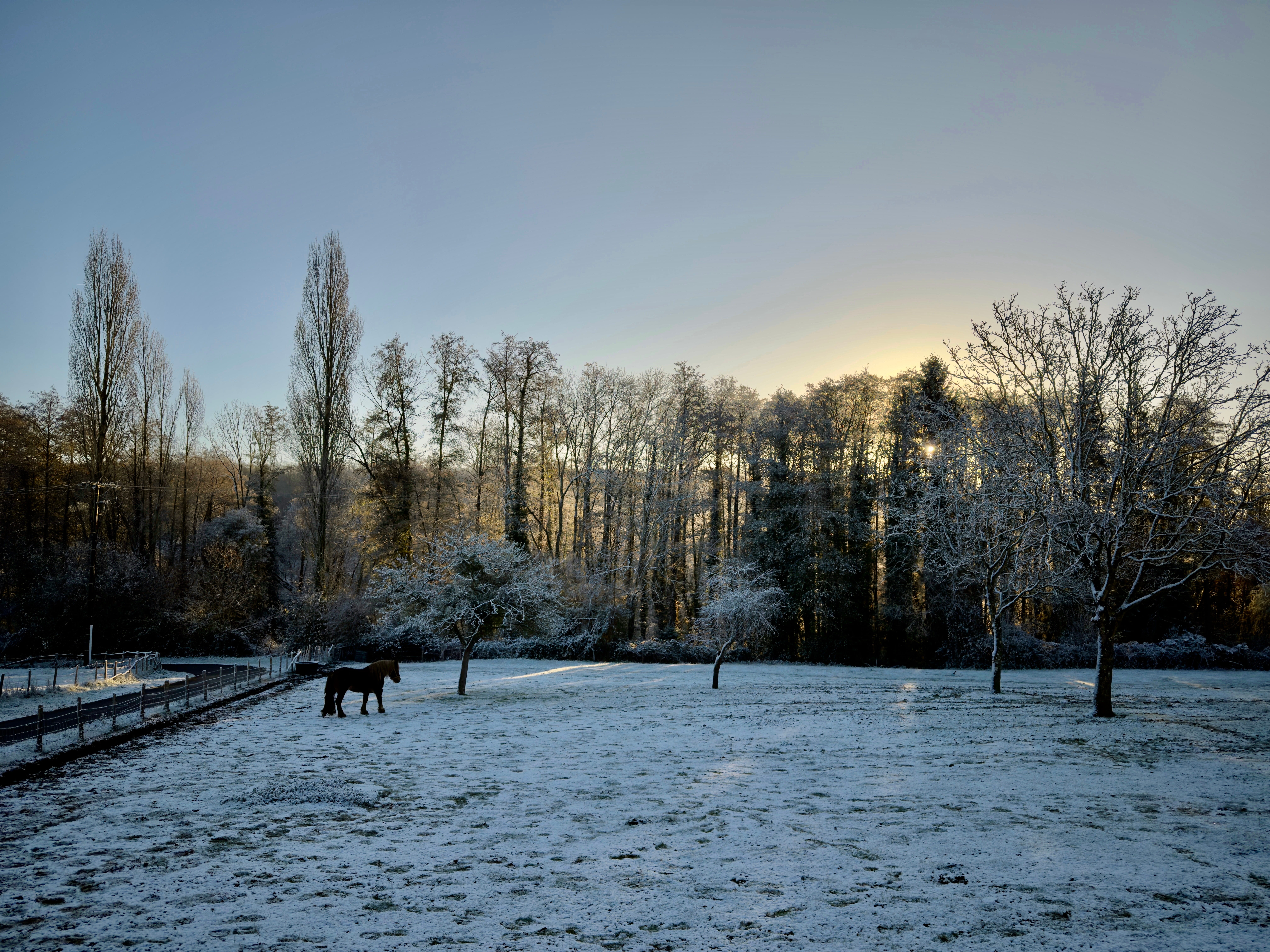
We inched ahead with arms locked. On the roadsides and in the gutters there were piles of graupel, the perfectly opaque white spheres that form when two types of precipitation combine and refreeze. Cassandre found it less slippery to walk on, and so she took the grassy side of the bank and ever so slightly crunched while I stayed on the blacktop and felt the ground give way the tiniest bit every other footfall. It was sunny, so we could see the mist rising from one of the horses in the adjacent pasture, which was sparkling under the light.
She told me she was working on a new ending for her latest novel, about a woman in her 60s who goes on a spontaneous trip to Tierra del Fuego after a separation. “Like you, she’s also facing a void,” she said. She told me she got the idea to set the book at the South Pole because she always wanted to go there herself, and the luxury of her own imagination meant she could visit in her own way every time she sat down to write. “I think I got the bug because I used to live near the Argentine métro. I passed by that sign every day. Argentine, Argentine, Argentine.”
Once we finished our short little crawl around the village, she invited me in for tea. I asked her about her grandchildren, all of whom I have met, most of whom I really like. She gave me their news, including that of the surgeon in training, the eldest of the lot. At their Christmas dinner, Cassandre told me he was grousing about how underpaid doctors are in France, and that to make a good living he might have to leave the country. He is not wrong about the woeful salaries of his profession, but his emphasis on money irked his grandmother.
“Do you know the first evidence of real human society?” she asked him. He didn’t know the answer, so she told him. “It’s in the femur,” she said. “When anthropologists saw that adult leg bones were reset, they understood we were finally forming communities. All species have an instinct to protect their young, but in the wild, when an adult animal breaks it’s leg, it’s certain death. At some point, humans decided that adults were worth saving too.”
She was repeating an apocryphal statement supposedly made by Margaret Mead that wasn’t technically accurate, but she wanted to emphasize to the young man the primacy of care in his mission. Then Jean-Yves, the eldest of Cassandre’s two sons, piped up. He has been retraining his hand as an illustrator in the last few months, hoping to start up a trade in garden portraits to go hand in hand with his budding landscaping business. It’s slow going but he’s committed.
“Maybe the one they decided to save was the one who sang the best,” he said.
As Cassandre finished her anecdote, I almost started to cry.
As I write this now, two Air Force jets are patrolling the skies near Saint-Maxime. Does breaking the sound barrier sound even more dramatic when the atmosphere is thick? The planes are another reminder that Europe is, little by little, rising to a war footing. I can only hope that, like Cassandre and I, they don’t lose their balance.
If it takes an army to protect a country, and a village to raise a child, then I leave you with Jean-Yves’ reminder that we will always need poets too.
"Does breaking the sound barrier sound even more dramatic when the atmosphere is thick? The planes are another reminder that Europe is, little by little, rising to a war footing. I can only hope that, like Cassandre and I, they don’t lose their balance."
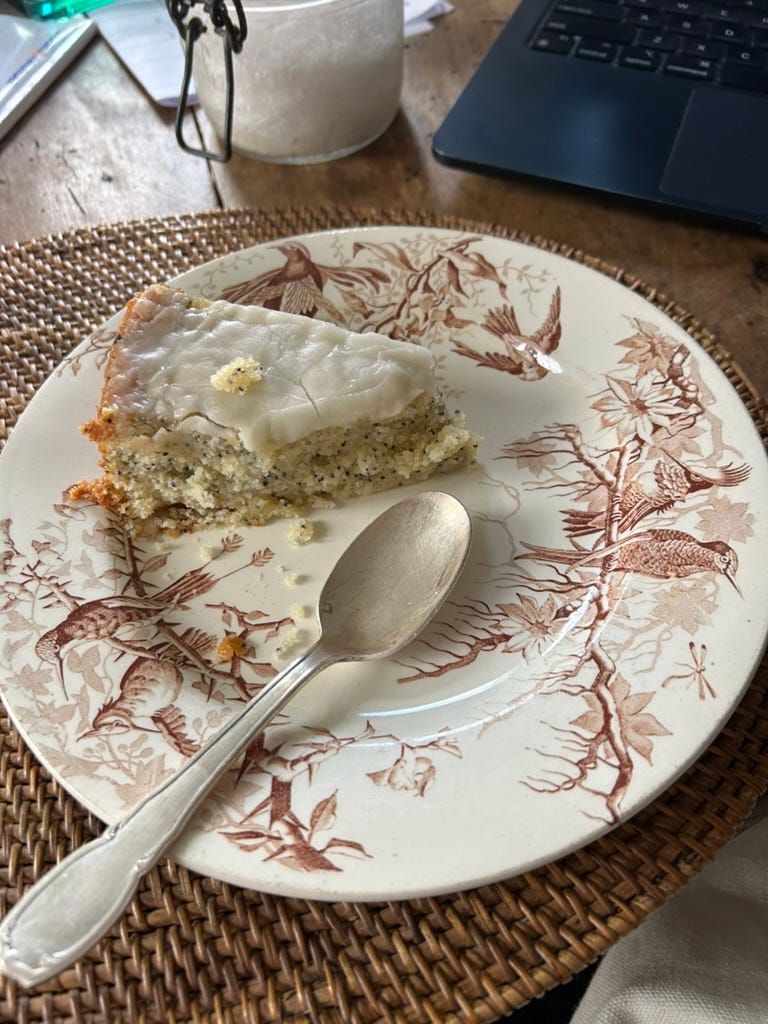
When has the quotidian ever been expressed so... poetically? Oh, sure, there was the French dude, Proust, always going on about madeleines and memory. I suppose it is fittingly selfish of me that what I want after reading the glorious word feast above... is the recipe for Michel’s lemon poppy seed rum cake. I would probably have more self-discipline were it not for the photo of the cake. Such a tease! :-)
Alexandra, this landed beautifully for me. The way you trace routine not as productivity theater but as ballast — something that keeps us upright when the ground keeps shifting — feels very true. And that image of walking arm in arm on ice, negotiating fear together, is such a quiet metaphor for how we survive these in-between seasons.
Also: “If you’re going to swirl into entropy, do it with a friend” might be the most practical life advice I’ve read all week. Thank you for this — for honoring care, repetition, and the poets we need to keep saving. 💛Kelly